
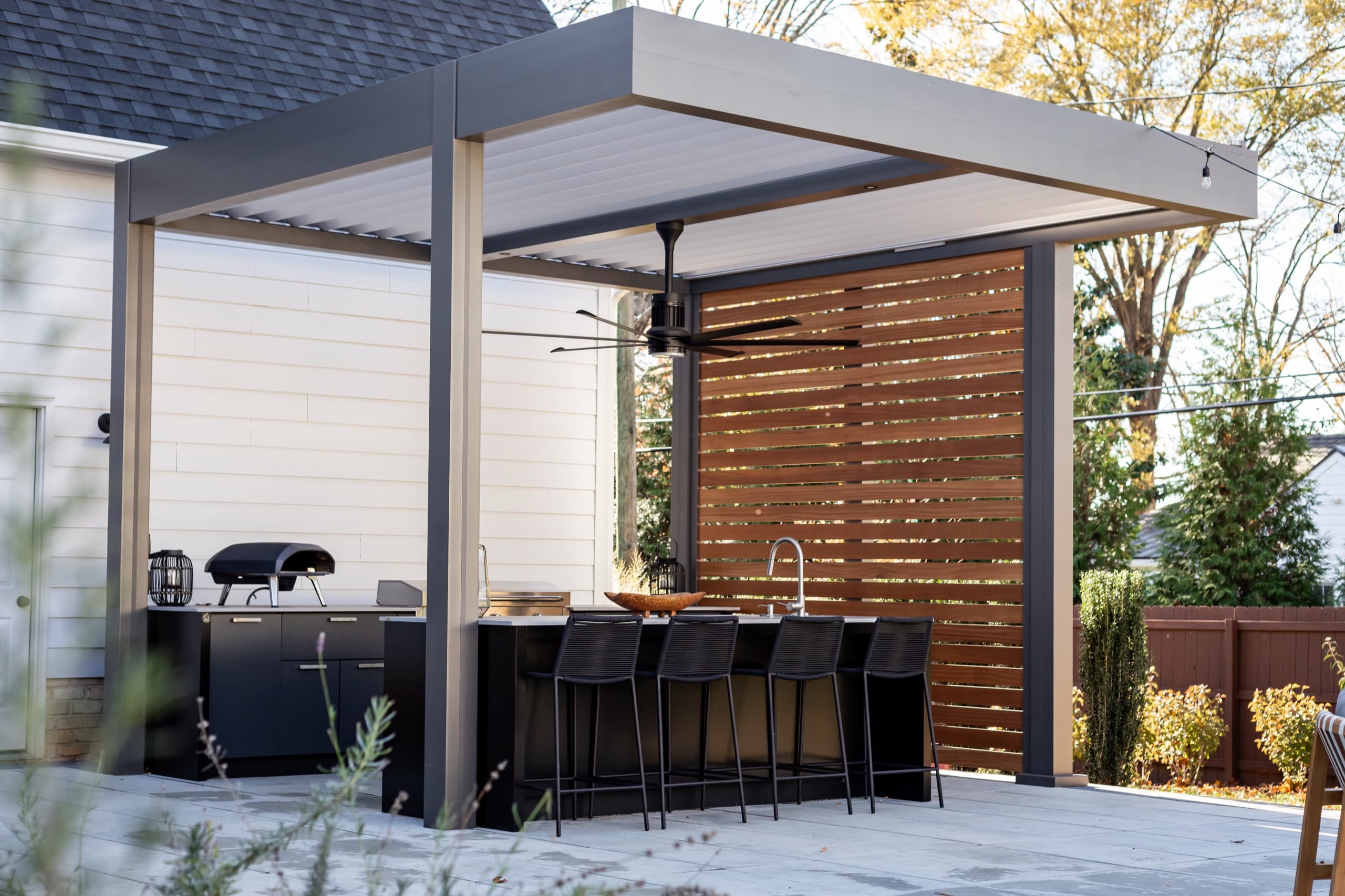
Pergola vs. Gazebo
Choose the structure by how you want the space to work
A gazebo and a pergola can both create a more useful backyard, but they solve different problems. Start with roof behavior, openness, layout, maintenance, and project scope before you request a quote.
Fixed destination or adjustable outdoor room?
If you want a defined place with a fixed roof, a gazebo may be the more direct fit. If you want to change the amount of sun and shade—or add motorized screens and other controls—EDG can help plan a motorized pergola.
Choose a gazebo when…
- You want one permanent roof and fixed overhead coverage.
- The structure should read as a standalone garden or entertaining destination.
- You are comfortable planning seating, lighting, and other features around a fixed footprint.
Choose a motorized pergola when…
- You want to move between open sky, filtered shade, and a closed roof position.
- Sun, glare, airflow, and changing weather affect how you use the patio.
- You want a coordinated system with screens, lighting, heating, or other controls.
Pergola vs. gazebo by the decisions that matter
The word “pergola” covers more than one roof type. An open decorative pergola and a motorized louvered pergola should not be compared as if they provide the same weather control.
Scroll horizontally to see all three columns. Focus the comparison and use the arrow keys with a keyboard.
| Decision | Pergola | Gazebo |
|---|---|---|
| Roof behavior | Open slats or adjustable louvers. Shade and rain control depend on the roof system. | Usually a fixed pitched or polygonal roof. The roof coverage stays in place while the sun and daylight change around it. |
| Openness | Open on the sides and visually connected to the yard; screens can be added to selected systems. | Often open-sided, but the roof form reads as a more defined destination in the landscape. |
| Layout | Can be freestanding, attached, or configured around an existing patio or outdoor room. | Usually a standalone focal point with a more fixed footprint and center of use. |
| Maintenance | Aluminum and motorized systems need cleaning, gutter care, and system-specific service. | Maintenance follows the material and roof: paint or stain, roofing, fasteners, drainage, and site work. |
| Best control question | Do you want to change the amount of sun, shade, airflow, and rain management during the day? | Do you want a permanent roofed destination with a predictable look and fixed overhead coverage? |
Fixed shade versus adjustable weather control
This is the most important distinction for many buyers. A fixed roof gives you a reliable overhead plane. A motorized louvered roof adds another layer: the ability to choose how much roof is open or closed as the day changes.
A gazebo stays consistent
The roof is part of the structure’s identity. That can be a strength when you want a clear focal point and dependable fixed coverage, but it also means the space does not open up when you want more daylight or airflow.
A motorized pergola can adapt
Louvered systems can open for light and airflow, angle for filtered shade, or close for rain management when the selected system, drainage, controls, and installation are right for the site.
Weather control is not the same as a sealed room
A motorized roof should be used according to its operating guidance in rain, wind, snow, and freezing conditions. Drainage needs regular attention. A rain sensor helps close the louvers; wind-driven rain can still enter from the sides. EDG plans the roof, drainage, screens, and controls around the way you want to use the patio.
Compare scopes before you compare prices
The roof, base, utilities, controls, engineering, and labor can all change the project category. Compare the work included in each scope before comparing totals.
Gazebo kit or simple structure
The scope may be a prefabricated kit or a straightforward build with a prepared base, assembly, and a fixed roof. The comparison is mainly the structure itself; utilities, drainage, and finished outdoor-room features may remain separate decisions.
Custom-built gazebo
A custom gazebo can add site work, foundation decisions, roofing, electrical, finish carpentry, access planning, and local review. It should be compared with another custom structure—not with a box-store kit.
Installed motorized pergola
The scope may include an engineered aluminum structure, motorized louvered roof, electrical, integrated drainage, controls, screens, lighting, heaters, and permitting or engineering coordination. Those additions are why a motorized pergola is a system project, not just a roof kit.
If a quote compares only the roof product, ask what is included for site preparation, electrical, drainage, engineering, permits, delivery, installation, and future service.
Think about the space after the first season
The better structure is the one that still fits how you move through the yard, host people, and care for the property months after installation.
Layout questions
- Is the structure attached to the home, freestanding, or part of a larger outdoor room?
- Do people need to move easily between the patio, yard, pool, and house?
- Will the roof need to work around doors, windows, views, utilities, or an existing deck?
- Does the seating plan need more than one condition: open, shaded, screened, or protected?
Maintenance questions
- A gazebo’s maintenance follows its roof, finish, fasteners, foundation, and surrounding drainage.
- A motorized pergola adds moving parts, controls, louvers, gutters, screens, and electrical components.
- Both options need leaves, standing water, and site drainage addressed before they become larger problems.
- A motorized roof and its moving parts benefit from routine care and clear operating habits.
Plan the motorized pergola around your patio.
For homeowners in EDG's local markets, we help plan a motorized pergola around the way you use the space, then coordinate design, engineering, permitting, installation, and care.
A gazebo may be the fit if…
Your priority is a permanent, recognizable destination with one fixed roof and a layout built around it. You do not need to change the overhead condition throughout the day.
Choose a motorized pergola when…
You want the patio to change with the weather and the way you use it. EDG will help plan dimensions, structure, drainage, electrical, controls, and the accessories that matter to you.
Pergola vs. gazebo questions
Is a gazebo the same as a pergola?
No. A gazebo is typically a freestanding structure with a fixed roof and a defined footprint. A pergola is usually more open, and a motorized louvered pergola can change the roof position to control sun, shade, airflow, and rain management.
Which gives better rain protection: a gazebo or pergola?
A fixed gazebo roof provides a consistent roof overhead when the structure, roofing, and site are properly built. A motorized louvered pergola can manage rain when its selected roof, drainage, controls, and installation are designed for that job. Wind-driven rain can still enter around open sides.
Is a pergola or gazebo cheaper?
A simple gazebo kit, custom-built gazebo, and installed motorized pergola include different work. Compare the foundation, roof, electrical, drainage, accessories, engineering, and labor included in each scope before comparing totals.
Do I need a permit for a pergola or gazebo?
Possibly. Requirements vary by jurisdiction, footprint, height, attachment, foundation, electrical work, setbacks, and local review rules. The building department or other authority having jurisdiction confirms the requirements for a specific property.
Want to see whether a motorized pergola fits?
Share the location and what you want the space to do. Photos or rough measurements are helpful but optional. EDG can start with system fit and help coordinate the right next step.